One number settles most of the Avast vs AVG debate before it starts: 1.3 billion dollars, the price Avast paid to buy AVG a decade ago. Since that deal, you have been comparing one company with itself. Both brands belong to Gen Digital, both run the exact same malware engine, and both sell a near-identical shelf of side products under two logos. So the honest verdict splits by situation, and we can give it to you right now. If you want the best price for covering several devices, get AVG Internet Security. If you want deeper control, a sandbox for suspicious files and a firewall you can actually configure, get Avast Premium Security. And for the four utility pairs that trail behind the flagship suites, the VPNs, the cleaners, the driver updaters and the privacy tools, the choice is even simpler: they are the same product twice, so buy whichever skin is cheaper on the day.
The rest of this article proves that verdict, pair by pair, across the full product lines. We also cover the one topic that deserves more attention than any feature list: the privacy record this family of brands carries.
The two brands grew up separately in the same country. AVG started life in 1992 in Brno, Czech Republic, as Anti-Virus Guard. Avast grew out of Prague. They competed for decades, which is why the internet still treats them as rivals. That rivalry ended in 2016 with the acquisition that opened this article. Six years later, Avast merged with NortonLifeLock, and the combined company took the name Gen Digital. The same parent now also owns Norton, LifeLock, Avira, and CCleaner.
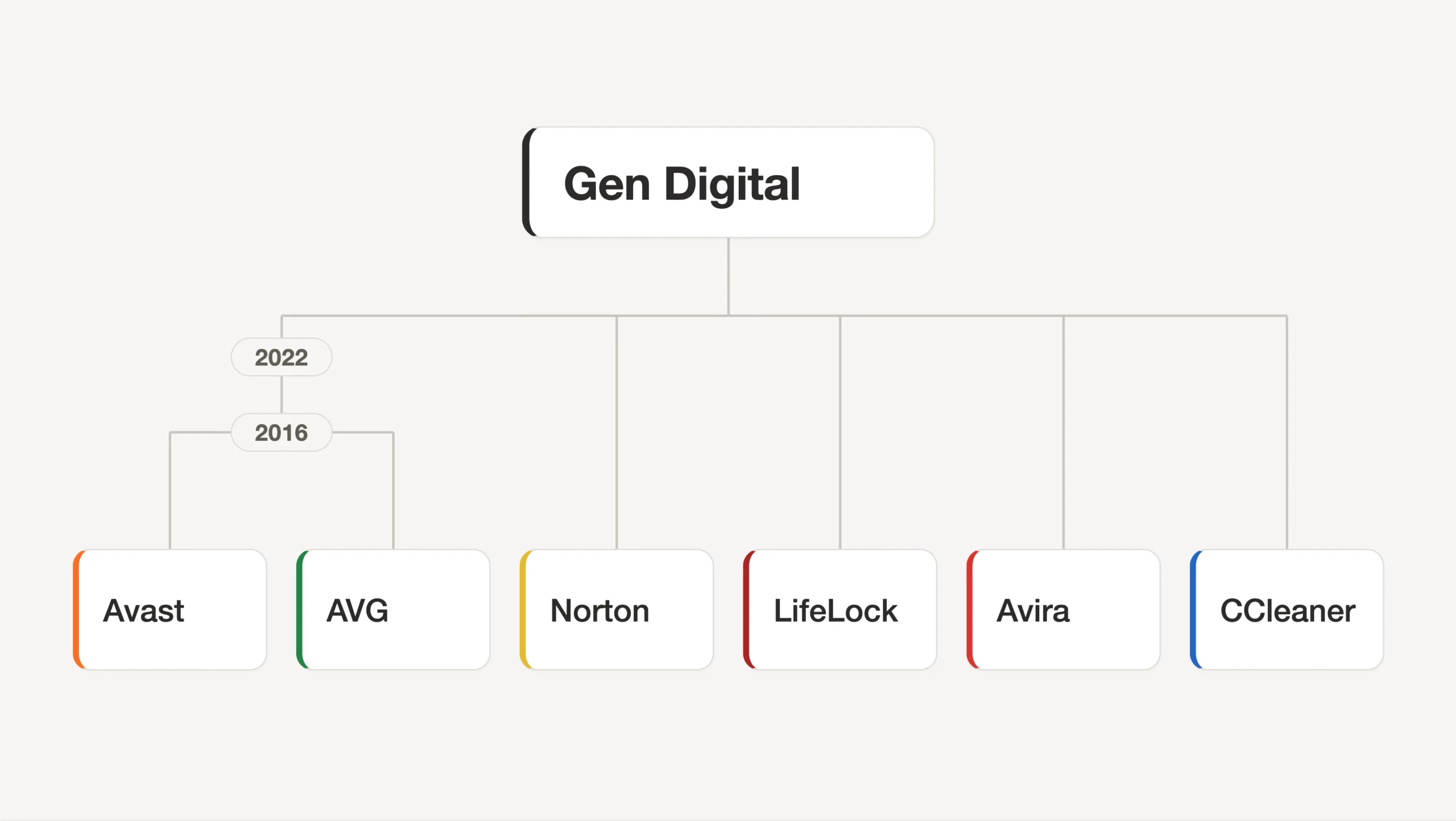
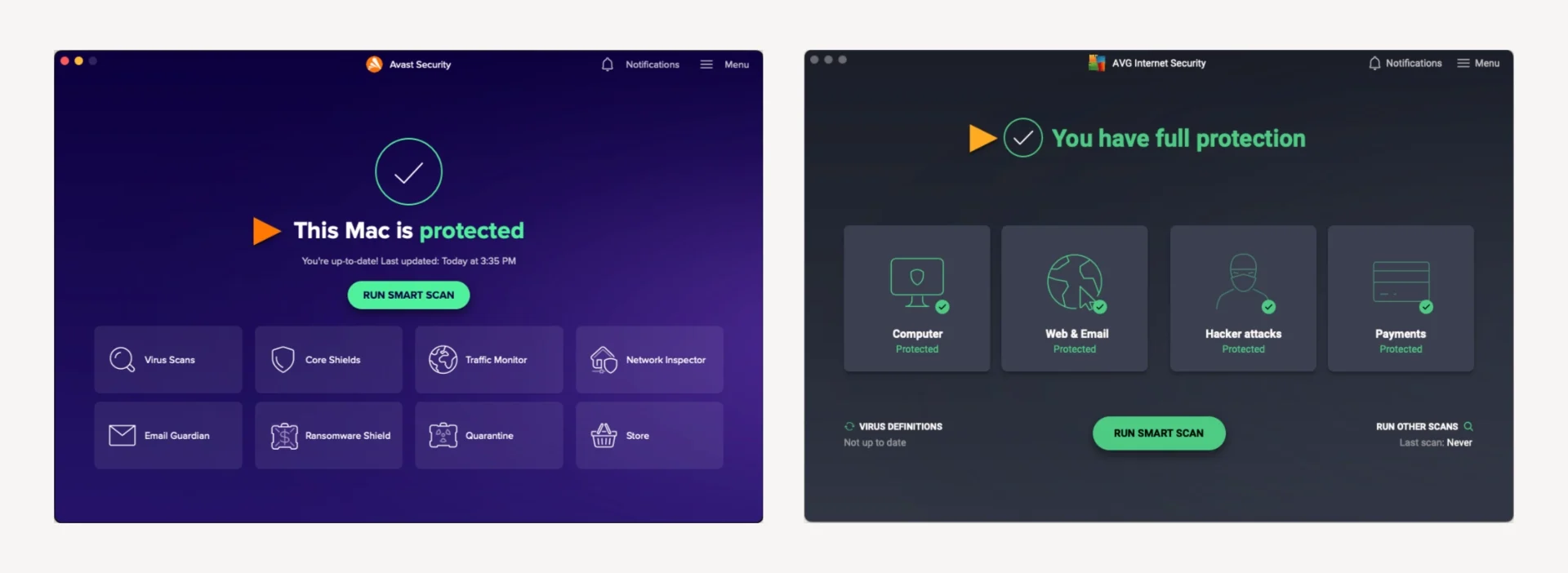
The acquisition did not keep the products separate under the hood. The detection engine, the virus databases, the heuristics and the cloud analysis were unified years ago. When independent labs test both, the scores come back identical, which is exactly what you would expect from one engine wearing two coats. AV-Comparatives has repeatedly published matching protection results for the pair and has given both the same annual awards.
Why keep two brands alive at all? Because each name still carries decades of loyalty in different markets, and two shelves in the store beat one. AVG built an enormous free-antivirus user base in the 2000s that still searches for it by name. Avast holds stronger recognition elsewhere. Running both lets the parent company capture the search traffic, the upgrade revenue and the bundle sales of two audiences while maintaining one engineering effort. That is smart business. It just means the rivalry you may remember is now theater, and a buyer who understands that shops differently.
That settles the question people ask first. Protection is a tie because protection is shared. So this comparison judges the things that are not shared: what each paid tier actually includes, how many devices a plan covers, how the pricing behaves after the first year, the small feature exclusives each brand kept, and the trust record behind the company. Those criteria decide every verdict below.
Here is the whole battlefield in one view, before we walk through it.
| Product pair | Same product underneath? | What actually separates them | Better buy |
|---|---|---|---|
| Avast Premium Security vs AVG Internet Security | No, small real differences | Firewall control, sandbox, network scan tier, device pricing | Split by use case |
| Avast SecureLine VPN vs AVG Secure VPN | ✅ Yes | Branding and bundle placement | The cheaper offer |
| Avast Cleanup Premium vs AVG TuneUp | ✅ Yes | Name and interface colors | The cheaper offer |
| Avast Driver Updater vs AVG Driver Updater | ✅ Yes | The logo on the window | The cheaper offer |
| Avast AntiTrack vs AVG AntiTrack | ✅ Yes | Interface colors | The cheaper offer |
| Avast BreachGuard vs AVG BreachGuard | ✅ Yes | The name on the box | The cheaper offer |
This is the pair where genuine differences survived the merger, and even here they are small.
Start with what Avast Premium Security keeps for itself. Its firewall is the most configurable in the family, with four operating modes and per-app, per-network rules, which matters if you like deciding exactly what talks to the internet. It includes a sandbox, an isolated space where you can run an installer you do not fully trust and watch what it does without risking the system. Its network scanner, the tool that checks your router and lists every device on your Wi-Fi, is available even on the free tier. Bank Mode opens a hardened desktop session for payments and online banking. A software updater that patches outdated apps ships free as well.
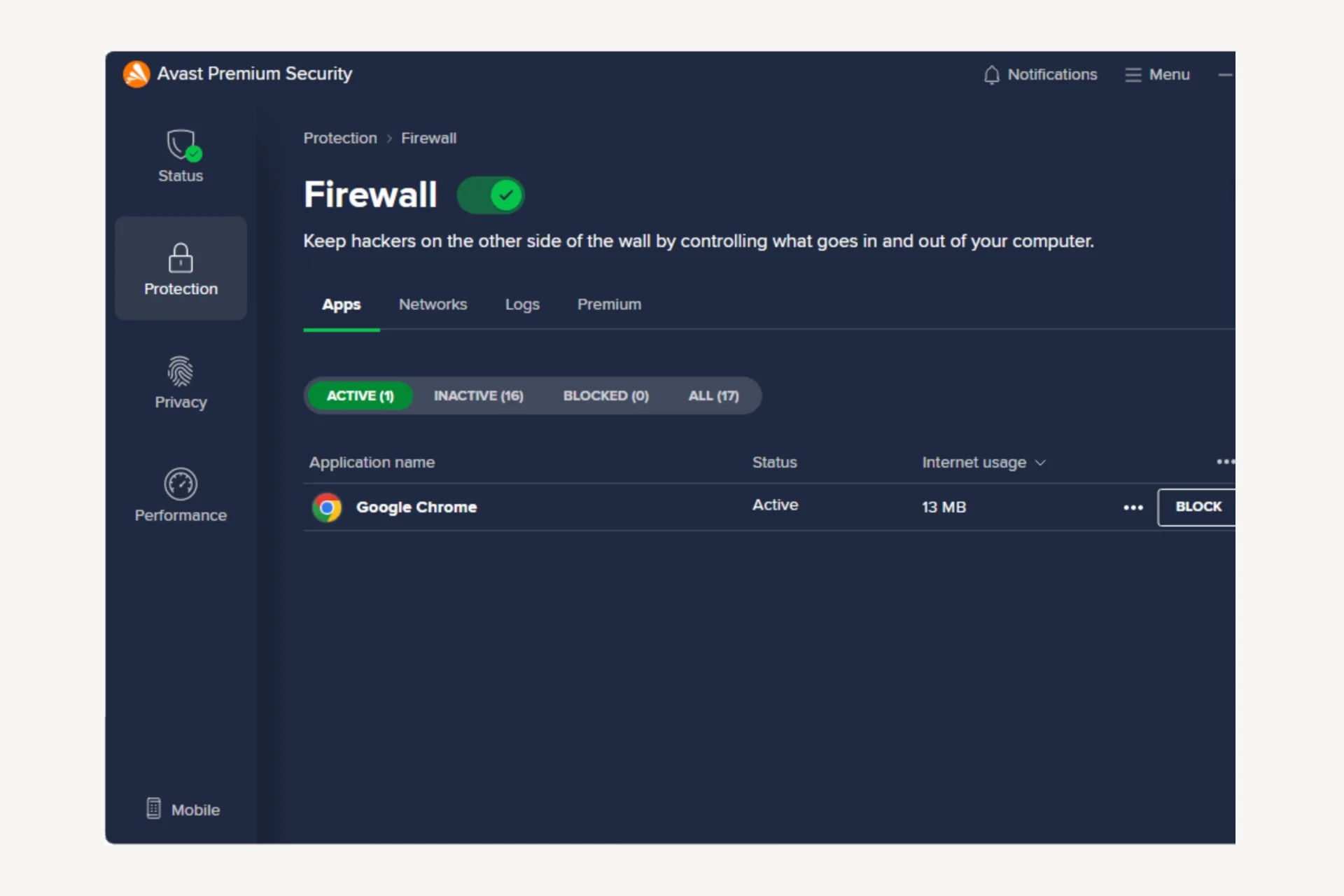
Avast’s weak spot is its own shop window. The brand currently sells two overlapping products, the classic Premium Security and the newer Avast One, with different packaging and different interfaces. Plenty of buyers end up unsure which one they own. AVG never split itself this way, and the simplicity counts for something.
AVG Internet Security answers with value. Its multi-device tier covers up to ten devices and its single-device price usually undercuts Avast’s opening offer. It kept two exclusives of its own: a payment protection module and a device lock feature on mobile. It gives up the sandbox entirely, locks the network inspector behind the paid tier that Avast hands out free, and its browser extension only supports Chrome. Users on older machines often describe AVG as the lighter of the two, though we treat that as reported experience rather than a measured fact, since the shared engine makes large gaps unlikely.
Most of each suite is the same suite. Both carry real-time scanning, a web shield that blocks malicious pages before they load, an email guard, ransomware protection that walls off your personal folders from unknown apps, a webcam shield that stops programs from switching your camera on quietly, a file shredder for deleting documents beyond recovery, and a quiet mode that silences popups while you game or present. One reviewer who compared the two product pages found several features described in the same wording on both, which tells you how the sausage gets made. None of those shared items should decide your purchase, because you get them either way.
The free tiers deserve a mention too, since a lot of readers comparing these brands never intend to pay. Avast Free Antivirus is the more generous package: it keeps the network scanner and the software updater that AVG reserves for paying customers. AVG AntiVirus Free covers the essentials, real-time protection, scanning and web filtering, with fewer extras around them. Both free versions advertise the paid products at you steadily, which is the price of free. If you only want a no-cost second opinion running on the family engine, Avast’s free tier gives you slightly more for the same amount of nagging.
Some absences are shared. Neither product offers parental controls, which pushes families toward rivals if that feature is a requirement. Both push upsell prompts at a rhythm you will notice, and both raise their price sharply at renewal, so the second-year cost deserves a look before the first-year discount wins you over.
The verdict for this pair follows the criteria. Covering a household of phones and laptops on a budget: AVG Internet Security wins on device count and entry price. Running one main PC and wanting to steer the firewall, isolate risky files and scan the network without paying: Avast Premium Security wins on control. There is no scenario where the protection itself differs, so pick by which of those two people you are. You can read how this shared engine’s built-in rival held up in our look at whether Microsoft Defender is enough on its own.
One warning applies to both camps and every antivirus on the market.
“Never run Avast and AVG at the same time. Two real-time antivirus engines fight over the same files, drag the system down and can destabilize Windows. Uninstall one fully before installing the other.”
The Rebrand Row: VPN, Cleanup, and Driver Updater
Move past the flagship suites and the pretense of competition drops away. These next three pairs are single products sold twice.
Avast SecureLine VPN and AVG Secure VPN are the clearest case. Reviewers who tested both services found the applications were the same program with different branding, which stops being surprising once you know both come from the same building. Server networks land in the same range of around thirty countries, far below what dedicated VPN providers offer. Both unblocked the big streaming services in reviewers’ tests and both handle torrenting. The catch is also shared: these VPNs keep connection logs that privacy-focused rivals refuse to keep, so treat them as a convenience layer for public Wi-Fi and region switching, not as a serious anonymity tool. The subscription structure is also unusual for the category, leaning on yearly and multi-year terms rather than the flexible monthly plans specialist VPNs sell, so read the term length before you commit. If a VPN is your main purchase, a specialist provider earns the money. If it is a bundle add-on, take whichever brand’s bundle is cheaper, because you are buying the same tunnels either way.
The bundles are where these twins usually reach buyers. Avast Ultimate wraps Premium Security together with Cleanup Premium, SecureLine VPN and AntiTrack. AVG Ultimate wraps Internet Security together with TuneUp, Secure VPN and AntiTrack. Look at those two lists again: they are the same four-part bundle assembled from the two skins. The bundles can be fair value if you genuinely wanted at least three of the four tools, and poor value if the suite was all you came for, since the standalone suite discounts are often deeper. Whatever you do, resist the idea of comparing Avast Ultimate against AVG Ultimate as if it were a decision. It is one bundle with two price tags, and the cheaper tag wins.
Avast Cleanup Premium and AVG TuneUp share a family tree that predates even the 2016 acquisition, since AVG had already absorbed the well-known TuneUp Utilities years earlier and that technology now sits behind both names. Each one clears junk files, trims the registry, puts background apps to sleep and nags you about programs you never open. How identical are they in practice? One AVG customer reported on the company’s own support forum that running an AVG TuneUp scan produced a message about their active Avast Cleanup Premium subscription. The product recognized itself across the brand line. Our advice on the pair is the same advice we give about most cleaners: modern Windows handles much of this housekeeping on its own, over-aggressive cleaning can delete things you wanted, and if you do want a cleaner, pay for the cheaper skin.
Avast Driver Updater and AVG Driver Updater do not even bother changing the name. Reviewers who ran both describe them as nearly identical, same scan flow, same install process, different logo. The tool has a real but narrow job: if Windows Update is not delivering drivers for a niche sound card, an old printer or a fresh monitor, a driver updater saves you the hunt through manufacturer pages. Most people never hit that problem. If you do, this is another cheaper-skin-wins purchase.
AntiTrack and BreachGuard: Same Tools, Different Colors
The last two pairs are privacy tools, and they follow the pattern to the letter.
It helps to be clear about what these tools are for, because the marketing blurs together. An antivirus stops malicious software. A VPN hides your location and encrypts your connection. Neither one stops a website from quietly building a profile of you, and neither one pulls your home address off a data broker’s directory. These two products exist for those last two jobs.
Avast AntiTrack and AVG AntiTrack fight browser fingerprinting, the technique sites use to recognize you even after cookies are cleared. Your browser leaks a surprising amount of identifying detail, the fonts installed, the screen size, the graphics hardware, the time zone, and combined those details point at you nearly as reliably as a name would. The software feeds trackers false details about your device and scrubs tracking cookies on a schedule. It covers ground that an antivirus and a VPN both leave open, since the antivirus does not stop tracking and a VPN only hides your location, not your browser’s fingerprint. That makes the category worth understanding. The two branded versions of it, though, are one product: an independent roundup of anti-tracking tools noted the interfaces match down to the layout, with the colors swapped. A hardened browser with a good content blocker gets a determined user most of the way for free, so consider that first, then buy the cheaper AntiTrack if you want the automated version.
Avast BreachGuard and AVG BreachGuard monitor whether your email addresses and personal details appear in known data breaches, then send removal requests to data broker sites that trade in personal information on your behalf. The removal-request service is the genuinely useful half, because doing that by hand across dozens of brokers is miserable work. Once again the two boxes hold the same product, and once again the decision is price. One extra note for this pair: free breach-alert services exist, so BreachGuard earns its fee only if the broker cleanup matters to you.
The twin pattern extends to phones as well. On Android, Avast Mobile Security and AVG AntiVirus for Android are built from the same components, scanning, app locking, anti-theft, photo vault, with the familiar two-color treatment. On iPhone, both brands offer slimmer apps, since Apple’s rules leave little for a third-party scanner to actually scan there. If you are choosing a mobile app from this family, apply the desktop rule without modification: same product, pick by price or by which desktop subscription you already hold.
Across all four of these utility pairs, the pricing behavior deserves the same caution as the suites. The first-year discounts are steep, the renewal prices are not, and every product in the family will regularly invite you to buy the others.
The Privacy Record Both Brands Carry
A comparison of these two brands that skips this section would not be honest, because the strongest argument against buying either has nothing to do with features.
Between 2014 and 2020, Avast collected detailed browsing data through its antivirus and browser extensions and sold it through a subsidiary called Jumpshot to more than a hundred third parties. Regulators found the data was detailed enough to be re-identifiable, meaning individual people could potentially be picked back out of it, while the products doing the collecting were being marketed as tracking protection. The company shut Jumpshot down in 2020 after public reporting exposed the pipeline. In early 2024 the US Federal Trade Commission fined Avast 16.5 million dollars and banned it from selling browsing data for advertising, and a Czech regulator had already issued its own penalty.
The Jumpshot pipeline ran under the Avast brand specifically. AVG’s name is not on the order, but the two brands answer to the same parent, share code and share management, so the episode fairly colors trust in the whole family. Weigh it however you see fit. The engine’s protection scores are real and the labs keep confirming them. The company’s history of monetizing the people it protected is also real, it is recent, and a privacy tool from this family should be bought with that history known rather than discovered later.
Which One Should You Actually Get?
The full product lines reduce to two decisions.
For the security suite, most people should buy AVG Internet Security. It protects up to ten devices, opens at a lower price and covers the same threats with the same engine. The person who should still buy Avast Premium Security is real and easy to describe: you want a firewall you can steer, a sandbox for files you do not trust and a free network scan, and you are willing to pay a little more for that control. Both camps should check the renewal price before checkout and expect upsell prompts after it.
For the VPN, the cleaner, the driver updater, AntiTrack and BreachGuard, stop comparing brands, because there is nothing to compare. Each pair is one product in two skins. Decide whether you need the tool at all, and several of them are optional for most people, then buy whichever brand is discounting harder that week.
Whichever logo you land on, install it once, from a genuine build. You can grab the official installers, delivered straight from the developer’s servers, on our Avast One and AVG AntiVirus pages.
Expect this arrangement to last. Two trusted names selling one engine is a better business than one name, so the twin act will run for as long as both brands keep converting searches into subscriptions. The day Gen Digital finally folds one into the other, this whole comparison becomes a history article. Until then, you know exactly what you are choosing between: a color scheme, a price tag, and a handful of suite features. Choose accordingly.